


European Society of Criminology


ESC Scholarly Awards and ESC Fellowships


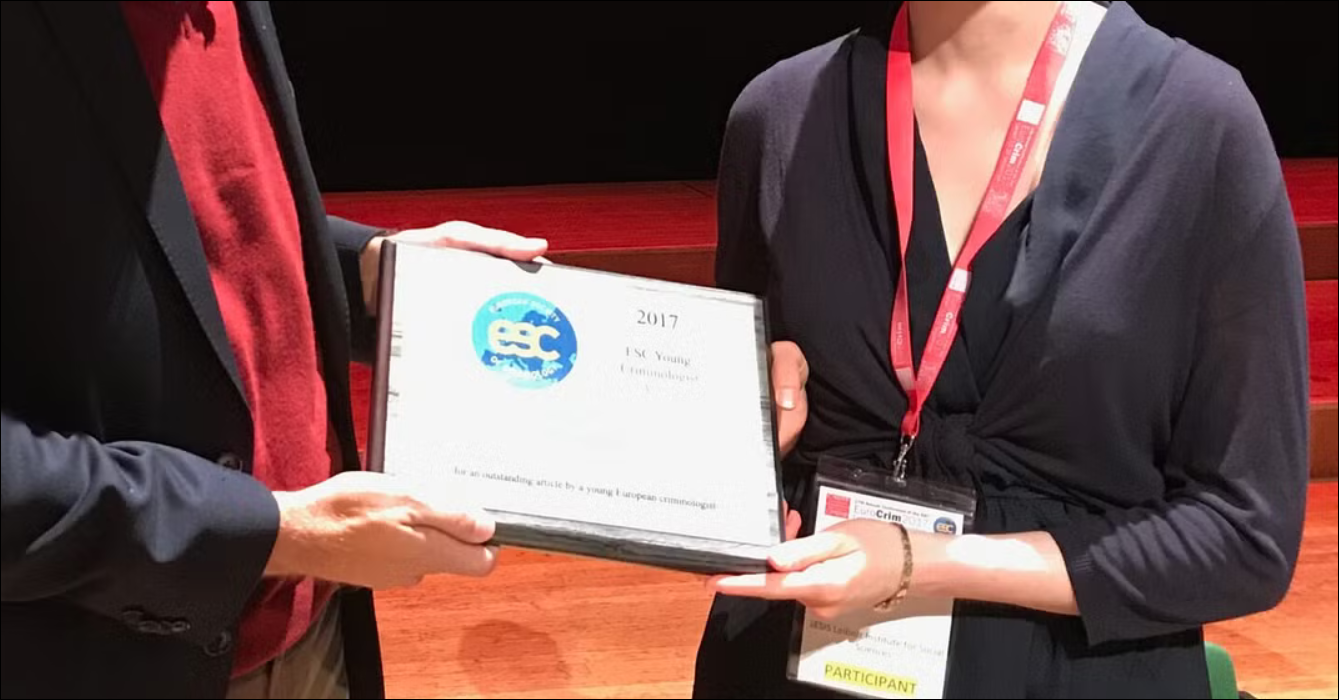
Since 2007, the European Society of Criminology awards annually two scholarly awards for career contributions by a European criminologist and for an outstanding article by a younger European criminologist.

Since 2009, the European Society of Criminology awards annually up to three fellowships to attend the Annual Conference of the Society.

ESC Scholarly Awards

ESC Scholarly Fellowship


Scholarly Awards

The European Society of Criminology awards annually two scholarly awards for career contributions by a European criminologist and for an outstanding article by a younger European criminologist.


The 2010 award committee for career contribution consists of former ESC presidents Kauko Aromaa (HEUNI, Finland), Krzysztof Krajewski (Jagiellonian University, Poland), and Elena Larrauri (Pompeu Fabra University, Spain).


The 2010 award committee for outstanding work by a younger scholar consists of Benjamin Goold (University of Oxford, United Kingdom), René van Swaaningen (Erasmus University, The Netherlands), and Tapio Lappi-Seppälä (National Research Institute of Legal Policy, Finland).


Rules of the ESC Awards

ESC European Criminology Award

The ESC European Criminology Award recognises the lifetime contribution of a European criminologist.

The terms 'criminologist' ('persons actually engaged in research, teaching and/or practice in the field of criminology') and 'criminological' relate to criminology as defined in Section 1 of the ESC Constitution ('The term criminology, as used in this Constitution, refers to all scholarly, scientific and professional knowledge concerning the explanation, prevention, control and treatment of crime and delinquency, offenders and victims, including the measurement and detection of crime, legislation and the practice of criminal law, and law enforcement, judicial, and correctional systems').

The jury consists of the most recent three Past-Presidents of the ESC. If one or more of such persons is unavailable, she or he will be replaced by the next previous Past-President. The ESC Executive Board is responsible for constituting the jury.

The jury will transmit its recommendation to the Executive Board by 30 April in a report that describes the process followed to reach a decision. The Executive Board may approve or disapprove the recommendation of the jury. It may also decide not to give the award in any given year.

Nominations should be forwarded to the Executive Secretary of the ESC by 31 January of each year and include (1) a letter of nomination explaining why the nominee's work warrants recognition, and (2) the nominee's curriculum vitae. The nominee must not have been a member of the ESC Board during the 5 years preceding the year of an award.


ESC Young Criminologist Award

The ESC Young Criminologist Award recognises an outstanding article by a European criminologist who was 35-years-old or younger when the article was published. The nominee must be the sole author of an article on a criminological topic published in a peer-reviewed journal in a European language within the three calendar years preceding the year of the proposed award.

The terms 'criminologist' ('persons actually engaged in research, teaching and/or practice in the field of criminology') and 'criminological' relate to criminology as defined in Section 1 of the ESC Constitution ('The term criminology, as used in this Constitution, refers to all scholarly, scientific and professional knowledge concerning the explanation, prevention, control and treatment of crime and delinquency, offenders and victims, including the measurement and detection of crime, legislation and the practice of criminal law, and law enforcement, judicial, and correctional systems').

A jury of three members will be proposed by the Editorial Board of the European Journal of Criminology to the ESC Executive Board. Each year, one member of the jury will be replaced by a new member.

The jury will transmit its recommendation to the Executive Board by 30 April in a report that describes the process followed to reach a decision. The Executive Board may approve or disapprove the recommendation of the jury. It may also decide not to give the award in any given year.

Nominations should be forwarded to the Executive Secretary of the ESC by 31 January of each year and include (1) a letter of nomination explaining why the nominee's work warrants recognition,
(2) the nominee's curriculum vitae,
(3) a copy of the original article,
(4) if the article is published in a language other than English, a translation of the article into English (unless all jury members speak or read another European language and the article is in that language), and
(5) a description of the journal in which the article was published, including a description of its peer-review process.


List of ESC Awards Recipients


European Criminology Award

2009: Josine Junger-Tas

2008: Lode Walgrave

2007: Anthony Bottoms


ESC Young Criminologist Award

2009: Georgios Antonopoulos

2008: Joris van Wijk

2007: David Green and Philip Verwimp


ESC Fellowships


ESC Fellowships to attend the Annual Conference of the European Society of Criminology


The European Society of Criminology (ESC) invites postgraduate or early stage researchers who are involved in criminological research to apply for a fellowship to attend the annual conference of the ESC. Applicants must be based in one of the following countries: Albania, Armenia, Azerbaijan, Belarus, Bosnia and Herzegovina, Bulgaria, Croatia, Georgia, Kosovo, Moldova, Montenegro, Romania, Russia, Serbia, The Former Yugoslav Republic of Macedonia, Turkey, and Ukraine. Up to three fellowships will be awarded each year.


The term 'criminological' relates to criminology as defined in Section 1 of the ESC Constitution ('The term criminology, as used in this Constitution, refers to all scholarly, scientific and professional knowledge concerning the explanation, prevention, control and treatment of crime and delinquency, offenders and victims, including the measurement and detection of crime, legislation and the practice of criminal law, and law enforcement, judicial, and correctional systems').


The fellowship includes the waiving of the registration fees for the conference plus an additional 500 Euros to cover travel and accommodation expenses.


A panel of three members designated by the Executive Board of the ESC (including, whenever possible, one member of the EPER -European Postgraduate and Early Stage Researchers Group- ESC Working Group) will review the applications and recommend suitable candidates to the Executive Board. The current panel consists of Krzysztof Krajewski (Jagiellonian University, Poland), Aleksandras Dobryninas (University of Vilnius, Lithuania), and Jenny Johnstone (Newcastle University, United Kingdom). The jury will transmit its recommendation to the Executive Board by 30 April in a report that describes the process followed to reach a decision. The Executive Board may approve or disapprove the recommendations of the Panel. It may also decide not to give the fellowships in any given year.


Applicants must forward their applications to the Executive Secretariat of the ESC and to Prof. Krzysztof Krajewski by midnight 31 January of each year. The application must include:


(1) A letter explaining why financial support is needed.
(2) A short letter of support from a professor or research supervisor.
(3) An abstract of their research presentation (to be included in the conference programme).
(4) A curriculum vitae.


Successful candidates will be notified by e-mail by 15 June of each year.


List of ESC Fellowships Recipients


2009 Fellowships

- Anna Maria Getos (Croatia)
- Aleksandra Jordanoska (FYRO Macedonia)
- Liljana Stevkovic (Serbia)


Print 
© ESC 2003 | esc@esc-eurocrim.org